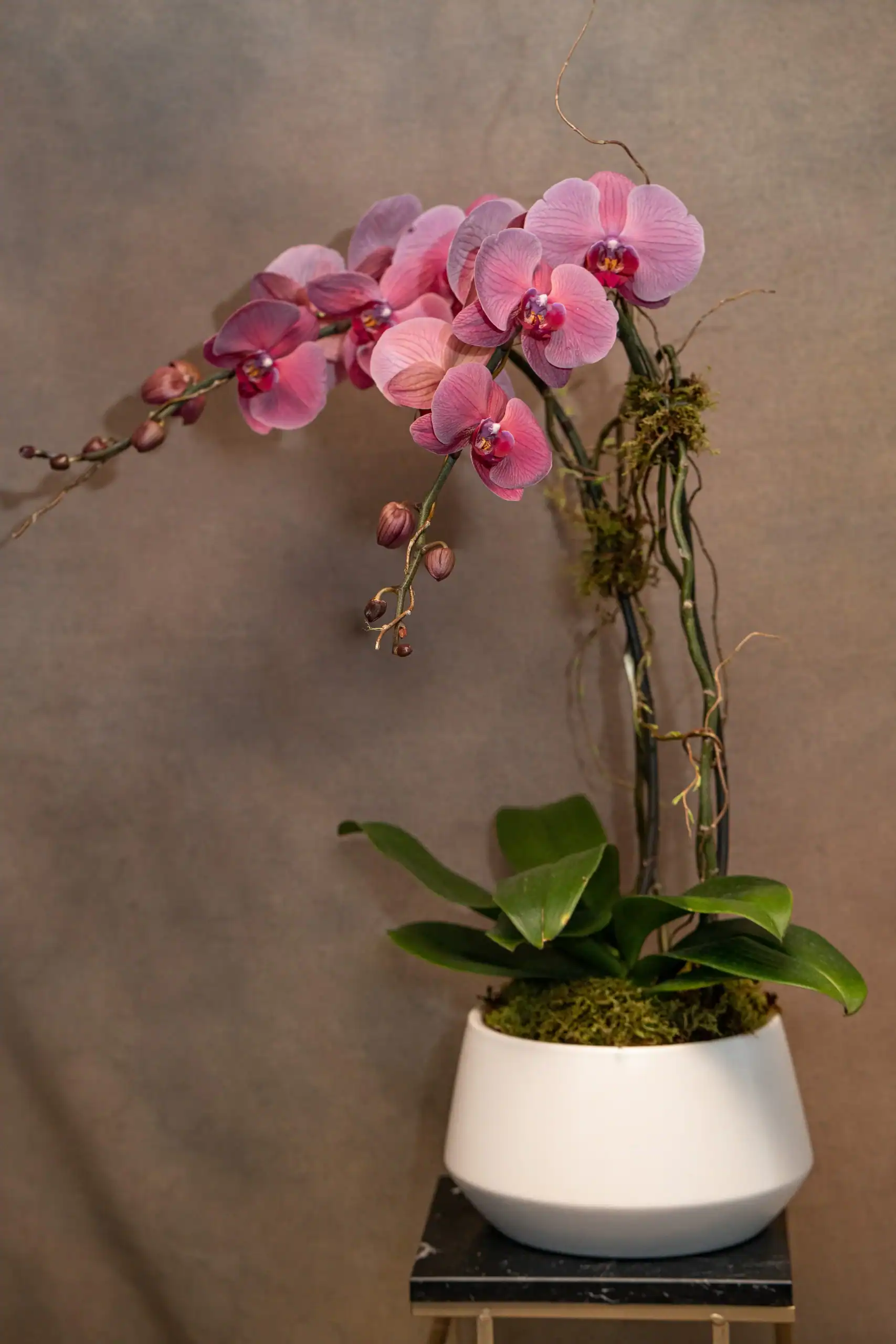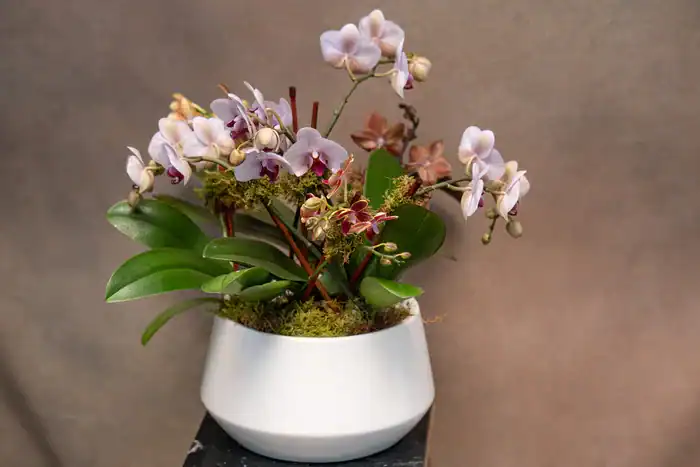
Got an orchid for Father's Day? Here's how to keep it thriving in a NYC Midtown apartment — dry air, city windows, and all.
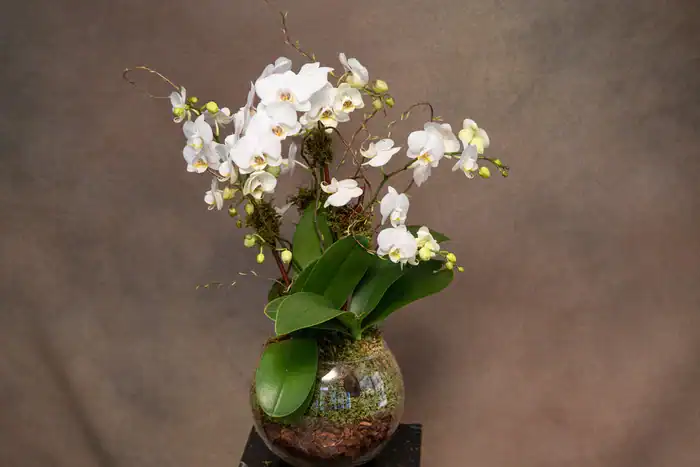
Orchids have a reputation they don’t entirely deserve. People assume they’re finicky, fragile, and destined to die on a windowsill within a month. The truth is, most orchids don’t die because they’re difficult — they die because of a few specific, avoidable mistakes that are especially easy to make in a Midtown apartment.
If you’re thinking about gifting an orchid this Father’s Day, or you’ve already got one on the way, this guide is for you. We’ll walk through exactly what keeps a Phalaenopsis orchid alive and blooming in a NYC Midtown apartment — and what quietly kills them before you notice anything is wrong.
Cut flowers are beautiful, but they’re gone in a week. An orchid in full bloom can last two to four months — which means a Father’s Day gift purchased in June can still be sitting on a desk or kitchen counter in September, looking just as good as the day it arrived. For a busy Manhattan dad who doesn’t want to fuss over a plant daily, that staying power matters.
Phalaenopsis orchids — the arched-stem variety you see most often — are also genuinely low-maintenance. They need water roughly every seven to fourteen days, indirect light, and a little humidity. That’s it. The “orchids are hard” reputation comes almost entirely from overwatering and poor placement, not from anything inherent to the plant itself.
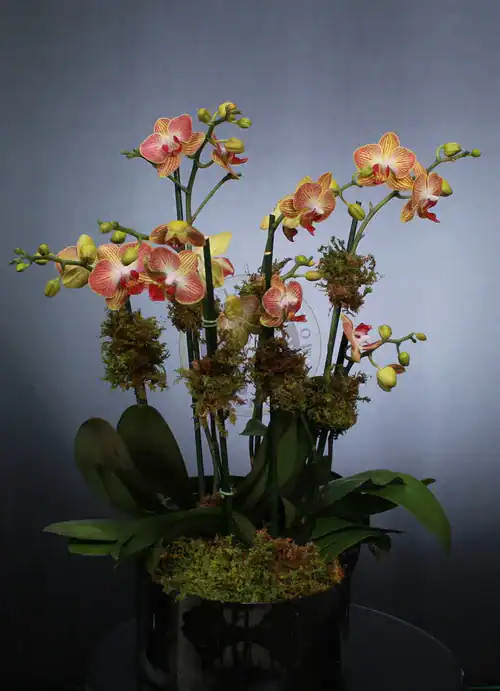
Overwatering is the single most common way orchids die, and it’s especially easy to do when you’re trying to be attentive. The instinct to water frequently makes sense for most houseplants — but orchids are different. Their roots need to dry out between waterings. When they sit in wet bark or soggy moss for too long, the roots rot, and the plant declines quietly from the bottom up before you see anything wrong at the top.
The right approach is simple: stick a finger into the growing medium — usually bark or sphagnum moss — and water only when it feels dry. In a typical NYC Midtown apartment, that works out to about once a week in summer and every ten to fourteen days in winter when the heat is running. When you do water, do it thoroughly. Take the pot to the sink, run lukewarm water through it until it drains freely from the bottom, and let it drain completely before putting it back on a saucer or tray.
One thing worth saying directly: do not use ice cubes. This is a care tip that got popularized by a specific brand of grocery store orchid, and it has no basis in how these plants actually grow. Phalaenopsis are tropical plants. Cold water shocks their roots. The Smithsonian Gardens explicitly warns against it. Room-temperature or slightly warm water is always the right call.
If you’re gifting this orchid to your dad and he’s not a plant person, write this down on a card or include a note. “Water every ten days, lukewarm water, let it drain” is genuinely all he needs to know to keep it alive for months.
Light is where NYC Midtown apartments create the most confusion for orchid owners. The conventional advice — “place near a bright window” — doesn’t account for the reality of city living, where the building across the street might block your east-facing window by 9 AM, or your south-facing window delivers a concentrated beam of direct afternoon sun that would scorch the leaves.
Phalaenopsis orchids need bright, indirect light. They cannot handle direct sun — it burns their leaves and stresses the plant. This actually works in their favor in dense urban environments. The filtered, diffused light that comes through a north- or east-facing city window, or a window partially shaded by a neighboring building, is often close to ideal. Direct sun is the enemy. Insufficient light is a slower problem, but it will eventually prevent the plant from blooming again.
A practical test: if you can comfortably read a book by the light near a window without turning on a lamp, there’s probably enough light for a Phalaenopsis. If the space feels dim even during daylight hours, consider moving the orchid to a brighter room or supplementing with a basic grow light — nothing elaborate, just a full-spectrum bulb on for a few hours each day.
For apartments in Midtown where windows face a wall of glass from the office tower next door, an east-facing windowsill in the morning is often the best option. The orchid gets gentle morning light, avoids the harsh afternoon heat, and stays well away from the drying effect of an AC vent — which we’ll get to next.
Want live answers?
Connect with a Columbia Midtown Florist expert for fast, friendly support.
This is the part that most generic orchid care guides miss entirely — and it’s the part that matters most if you live in New York City. Midtown apartments face what you might call a double-dry effect: forced-air heat from October through April strips the indoor air of moisture, and then central AC takes over from June through September and does the same thing. Orchids prefer humidity between 40 and 70 percent. A typical Midtown apartment in winter can drop to 10 or 20 percent.
That gap is real, and it shortens the bloom cycle, stresses the plant, and can cause buds to drop before they even open — a frustrating phenomenon called bud blast. The good news is that it’s one of the easiest problems to fix.
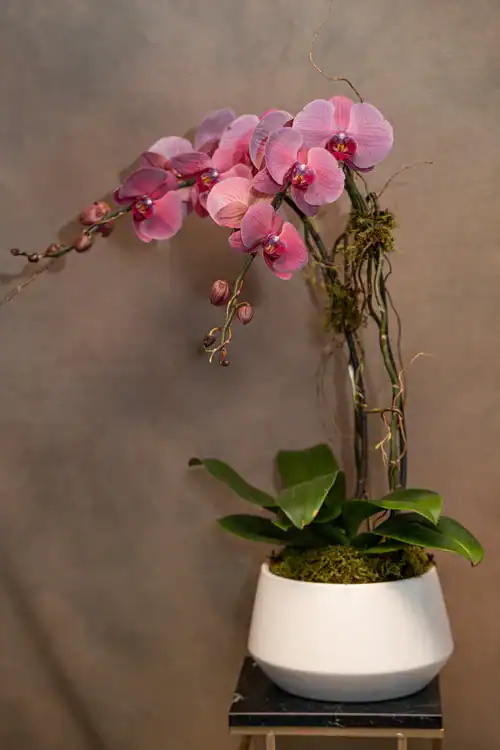
You don’t need a humidifier — though one certainly helps if you already have one. The simplest solution is a pebble tray: a shallow dish or tray filled with small stones, with water poured in just below the top of the pebbles. Set the orchid pot on top of the pebbles so it sits above the waterline, not in it. As the water evaporates throughout the day, it creates a small humidity microclimate directly around the plant. It costs almost nothing and requires almost no effort.
A bathroom windowsill, if it gets reasonable light, is actually one of the best spots in a Midtown apartment for an orchid. The steam from daily showers naturally raises the humidity in that room, and the plant benefits without any additional intervention. It sounds counterintuitive — most people don’t think of the bathroom as a plant space — but for orchids specifically, it works well.
What you want to avoid is placing the orchid near a heating vent, a radiator, or directly in the path of an AC unit. These are the spots where the air is driest and the temperature swings are most extreme. A Phalaenopsis sitting on a windowsill above a radiator in a prewar Midtown building is going to struggle, no matter how carefully you water it. Move it a few feet away from the heat source and the difference is noticeable.
If the apartment is genuinely dry — as many Midtown high-rises are in winter — misting the aerial roots lightly in the morning can also help. Don’t mist the flowers directly, as moisture on the blooms can cause spotting. Just a light pass over the roots and leaves a few times a week adds meaningful humidity without creating conditions for rot.
This is the question that comes up most often after the initial bloom ends, and it’s the one that surprises people the most when they hear the answer: your orchid is not dead. When the flowers drop after two to four months, the plant is simply resting. It’s a natural part of the cycle, not a sign that you did something wrong.
Getting a Phalaenopsis to rebloom takes one specific trigger: a modest temperature drop over several weeks. In a Midtown apartment, this is easier to achieve than it sounds. In early autumn — September or October — crack a window in the evening and let the temperature near the plant drop to around 55 to 65 degrees Fahrenheit for a few weeks. That cool period signals to the plant that it’s time to set a new flower spike. You’ll see a small green nub emerge from the base of the leaves or from the existing spike, and within a few months, you’ll have another full bloom cycle.
This means the orchid your dad receives for Father’s Day in June has a real shot at blooming again around the holidays — which is a remarkable thing for a gift to do. Most Father’s Day presents don’t make a second appearance in December. A well-cared-for Phalaenopsis does.
One note on the spent spike: once all the flowers have dropped, you can cut the spike back to just above a visible node — a small bump along the stem — rather than removing it entirely. Sometimes the plant will produce a secondary bloom from that node before going fully dormant. It doesn’t always happen, but it’s worth leaving the option open rather than cutting the spike down to the base immediately.
For anyone in NYC Midtown who’s tried this before and had an orchid that never rebloomed, the temperature drop is almost always the missing piece. Midtown apartments stay consistently warm year-round, which is comfortable for people but removes the seasonal cue that orchids need to initiate flowering. A few cool evenings near an open window in September is usually enough to get things moving again.
Orchids are genuinely one of the better Father’s Day gifts you can give someone in a Manhattan apartment — they’re elegant without being fussy, they last for months, and they improve the space they live in rather than just sitting in a vase for a week. The care is simpler than most people expect, and with the tips above, there’s no reason a Phalaenopsis can’t thrive through summer, autumn, and well into the next year.
We source fresh orchids each morning from the NYC Flower District and hand-deliver throughout Midtown in climate-controlled vehicles — which matters more than it might sound when Father’s Day falls in June and the city is already heating up. Every orchid we deliver is chosen for quality, not convenience, and we include care guidance so the recipient knows exactly what to do from day one.
Reach out to us at Columbia Midtown Florist to place your order — same-day delivery is available for orders placed before 2 PM, and we’re located at 3 West 51st Street, steps from Rockefeller Center, if you’d rather stop in and choose something in person.
Summary:
Article details:
Share: